Category: Uncategorized

  • We live in interesting times

    Back from the NRA Annual Meeting. For those playing at home, here’s some of the political highlights:

    Wayne LaPierre released a letter stating that Oliver North and Ack-Mac told him to resign. If he didn’t, they would release material that would be “bad for him, and at least 2 of the board members on the executive committee.” Wayne responded the way you should to extortionists: publicly called them out on it.

    North sent a minion to inform the board that he “would not be seeking re-election” as president of the org. Since his term would be up as of the end of the meeting, I consider this the same as resigning. Given the situation, I would also consider this resignation as being in disgrace. He is still a board member for another 3 years (unless the ethics committee decides to remove him). That said, given that he failed to make an appearance after Friday, including the president’s dinner, and board meeting, I doubt he will show his face again.

    During the general member’s meeting, there were several calls for LaPierre to step down, an investigation into a couple committees, and other series issues. These were all sent to the board to be dealt with.

    I have seen reports that the executive committee of the board quickly closed the doors on the rest of the board during the board meeting, and the committees that were called out in the general members meetings were basically told to investigate themselves. Surprising no one, the boards found nothing wrong.

    The entire slate of the executive committee and vice presidents were re-elected unanimously, and uncontested. All I’ll say about that is that it’s hard to see change when no one new puts their hat into the ring.

    Caroline Meadows was elected as president. I don’t know enough about her to really comment, but from what little I’ve seen, it’s probably business as usual.

    Oh, and the New York AG has announced that she’s investigating the NRA, with the possibility of considering whether or not the NRA should maintain it’s tax exempt non-profit status. It’s no secret that New York politicians are no friends of the NRA, and I’m sure that they’re smelling blood in the water.

    My personal take on all of this? There was a lot of talk that this year might end up being as famous as the Cincinnati revolt. It’s clear to me that the board is trying as hard as it can to stop that from happening. I have espoused that the NRA needs a serious leadership change for a long time. LaPierre’s speech after Sandy Hook blaming the shooting on “those damn violent movies and video games” lost us a lot of friends that weren’t really gun people. The leadership has repeatedly proven itself to be out of touch.

    That said, the NRA is currently in a bad spot. It’s in a lawsuit with what is essentially its PR and outreach branch, its President had to step down in disgrace, and its enemies are circling. Also having to scramble to replace the Executive VP might be a bit much, and, as much as I want to see LaPierre gone, North and Ack-Mack were possibly worse.

    Next year’s NRAAM should be… interesting, as well.

    Hopefully, when everything is said and done, the NRA will be better and stronger. If we’re lucky, it will be an org that focuses on the 2nd amendment, and leave all the “conservative principles” stuff to other groups.

    Next post should be on products I saw at the con.

  • Well, this could be interesting.

    NRAAM may be highly interesting this year.

    We have the continued blowback from the Benchmade debacle.

    Both Trump and Pence are going to speak, where I’m sure that Trump will declare himself the most pro-gun president ever… despite his actions since taking the position.

    And, of course, there’s the fun that it was recently announced that the NRA is suing Ackerman McQueen, which is the advertising firm that run, among other things, NRATV.

  • Overheard at the Office

    “Hey, Oddball! Have you seen the filter rules for the firewall?”
    “no…”
    /me reads the list of site types we’re blocking, which includes “hacking,” and “weapons.”
    “well… I can tell you right now that this firewall’s filter isn’t working.”

  • With Friends Like This…

    For those that don’t know, when it comes to pro-gun rights groups in the state of Tennessee, you pretty much have the Tennessee Firearms Association and… the Tennessee Firearms Association.

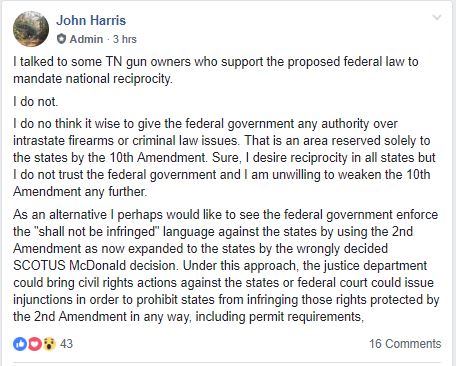
    Recently, John Harris, the man who has lead the TFA for a long, long time posted this:

    Just in case you’ve somehow stumbled on to this blog without knowing what the McDonald v Chicago case was about, welcome! and I hope I manage to enlighten and entertain! The case dealt with whether or not it was constitutional for the city of Chicago to straight up ban the ownership (not just carry of) handguns in its city limits.

    The short of it is that the court decided that the 14th amendment means that the states are under the same constitutional restrictions that the Federal government is, and that includes the 2nd amendment.

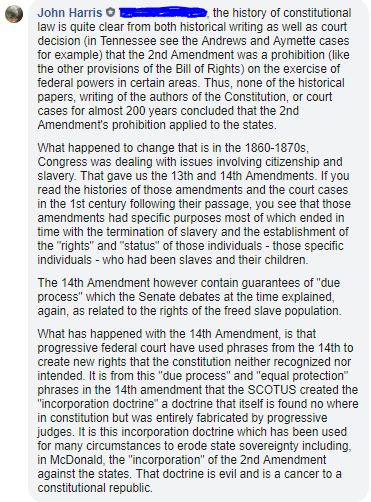
    Being a little alarmed that the head of my states “only no-compromise gun organization” would refer to “the wrongly decided SCOTUS McDonald decision,” I ask him for clarification. This was his answer:

    In short, it is his belief that the 14th amendment’s due process clause does not mean that the constitution applies to the states as well as federal government. Never mind that, besides a handful of court cases shortly after the amendment was passed, the courts has regularly held it to mean just that.

    Which means that, yes, the head of my local state level pro-gun rights org does not believe that the 2nd amendment applies to state level legislation. I’m guessing, by the same token, he doesn’t believe that state or city governments are restricted by any of the other amendments in the Bill of Rights… or the rest of the constitution, for that matter. Sorry, beyond “don’t own slaves.”

    So… in case you were wondering, I know that my friend Weer’d Beard is a fan of tell you to join multiple national level gun rights groups *and especially* your state level ones, but… I’m not going to be opening my check book for the TFA anytime soon.

    By the way, Mr Harris’ day job? He’s a lawyer.

  • Happy Pi day

    In whatever form you like enjoying it
  • The Most Tennessee Tennessee Beretta that ever Tennesseed

    A while ago, I had made a deal with the wife that I was allowed to buy another Beretta when I found that said “Made in Gallatin, TN” on the side of it. She couldn’t deny the cool factor of having a gun made in a suburb of the town we live in.

    Unfortunately, a good chunk of the guns coming out of the Gallatin facility merely have “Made in the USA” imprinted on the side. The ones that don’t are either things like the Langdon Tactical 92G, which has been outside of my price range, or the Nano, which… as much of a Beretta fanboy as I am, I just don’t like.

    Then I found out that Beretta was coming out with an limited run of 1000 92s to celebrate the move to Gallatin.

    Definitely a “special edition,” but not obnoxious about it

    The “92G Brigadier Volunteer” comes with walnut grips with the tri-star image from the state’s flag, symbolizing the three regions of the state, the 1796 inscribed in the slide is the year the state was founded, and, of course, Tennessee is nicknamed “the Volunteer State.” Oh, and to finish off the references, the serial numbers of this line all start with “TN.”

    Good use of the extra real estate on the Brigadier slide

    Of course, this edition of 92s aren’t just for show. Immediately obvious is the Brigadier slide. While this was originally created to deal with concerns over cracked slides on the early 92s, and can help with dealing with more powerful +p loads, it’s also a little bit of extra weight, which helps it be very soft shooting pistol.

    As folks that are familiar with the 92 series will notice, this is a “G” series gun, which means that the lever on the slide is a decocker only, and there is no safety. This is the preferred configuration of most folks that actually carry or compete with these pistols. I have carried my Px4 in this configuration for a while now, and am confident that it is safe with the hammer down, and I don’t have to worry about accidentally engaging the safety.

    They also decided to upgrade the hammer to the skeletonized “Elite” hammer, and upgrade all of the parts that are plastic in the base 92 with metal pieces. Honestly, I’m not sure what, if any advantages these upgrades actually have over the original.

    There are three things that they leave out of this edition that many people like in the more high-end versions of the 92. The first is the lack of a rail for lights, etc. Honestly, I don’t plan on adding a light or laser to this gun, and I prefer the look of the original frame versus that of the A1 with the rail.

    The second is the grip. It seems that everyone likes the thinner straight “Elite” grip, and it is what they have chosen for the Langdon, M9A3, and other “premium” 92s. Personally, my giant hands find the original grips with the hump in the back more comfortable, but mileage clearly varies on that one.

    Lastly, the 2 magazines that are included with this pistol are the original 15 rounders. I personally prefer the 17 round mags. I do plan on carrying this guns as a BBQ gun, and I will probably grab a couple 17 round magazines when I do.

    The important (to me) imprint of where it was built

    As for the trigger pull, I did have the opportunity to dry fire one of the Beretta factory Langdon M9s when I bought this pistol, and could tell no difference. Whether that means that Beretta threw in a “D” hammer spring with the Volunteer, like they advertise that they do with the Langdon, or if I simply am not expert enough to tell the difference, I could not tell you. What I can tell you is that the single action is pretty light and crisp, while the double action is heavy, but smooth and consistent.

    All this is makes for a pretty gun, but, for me, the final question is “how does it shoot.” In a word: marvelously. It being a 92, I wasn’t concerned with its reliability, and it has yet to give me a reason to be so. I’ve found that it is extremely accurate (yes, even in double action), and very quick to return to target.

    Things have been… rather wet… around here lately, and the indoor range I’ve been going to maxes out at 10 yards. That said, I had no issue keeping all 15 rounds of a magazine in a ragged hole on the target, and I expect that any experienced shooter should be able to easily place rounds where they want them within standard pistol ranges.

  • Knife Grinds

    *NOTE: This is a transcript of my segment from Assorted Calibers Podcast episode 33*

    Welcome to Oddball’s corner pocket. This week, I thought I’d talk about the various grinds that are commonly used and why you would use one over the other. Oh, and if you’re into drinking games, you can take a shot every time I say “grind” in this segment. Warning: you may get alcohol poisoning.

    First, I think I should probably explain what I mean by “the grind.” While there are some knives where the thickness of the knife blade is the same at the spine as it is where the edge, or bevel actually starts, it’s fairly standard for the knife’s material to thin out at some point, so that it’s thicker at the spine than at the bevel. More material at the spine means that the knife is stronger, but a thinner blade makes it easier to slice through things.

    Probably the most common is the saber grind. As the name implies, this was the standard grind with swords like the saber, and is kind of the default for knives. The sides of the blade are roughly parallel with each other at the spine. At some point, the grind starts with a very shallow angle on both sides, and then that angle is changed to a steeper bevel right at the edge.

    Like I said, this is pretty much the default, and it’s pretty much the middle ground of all the grinds that I’m going to talk about. There’s other options that are better slicers, but aren’t a strong. Others are stronger, but harder to make and keep as sharp, etc. Honestly, whatever the purpose of the knife, I don’t think you would be going wrong with this grind. It’s also basically the grind that most other grinds are based on.

    The one that might be considered more basic is the scandigrind. Basically, a scandigrind is a saber grind that skips out on bevel at the edge of the blade. This results in the angle at the edge being extremely narrow. This makes the knife an excellent slicer that can be extremely sharp. Unfortunately, there are a couple issues with this design. The first being the problem with any knife with a very narrow edge: namely, a more fragile edge. It doesn’t seem to be a huge deal, if the manufacturer knows what they’re doing, but I’ve seen reports of well known knife makers come out with a scandigrind knife that constantly had it’s edge roll on people.

    Another issue is that a lot of folks have issues with sharpening this type of grind. It’s not so much that it’s difficult, but that folks don’t understand what they have. If you have one of these knives, and you want to sharpen it, just think of the edge as the entire grind. Sharpening it at more traditional angles will probably actually dull the blade.

    This grind’s name comes from the fact that it’s incredible popular with Scandinavian knife manufacturers. In fact, the traditional Finnish Puuko knife uses this style grind. Of course, I can’t mention the scandigrind without mentioning Mora knives, and their excellent budget knives. Some other knife companies that put out good knives using this grind are Helle, and Marttini.

    So, if we go back to that saber grind, and push that initial angle all the way to the spine, we’ve got a full flat grind. The advantage of this is that the initial angle can be a little shallower. This makes it a little better at slicing, even though the angle of the actual edge may not change. Since the angle of the grind isn’t much different than a good saber grind on a similar knife, you’re also not losing much strength to the blade. I have been noticing that Spyderco has been putting out a lot of full flat grind knives in the past few years, and some other companies have pushed the initial grind on their saber grinds so far back that they might as well be full flat grinds.

    The classic way to have a better slicer than the saber grind is what’s called a hollow grind. With a hollow grind, instead of having a set, straight angle to your grind, the grind is actually a concave curve. This means that the blade thins out very quickly, and stays at that narrow thickness right up to the bevel. I’ve seen this style grind on a lot of kitchen knives, and it does make for excellent slicers. Oh, and the stereotypical old fashioned, fold out razor blade is a hollow grind. The downside is that, since more of the blade is thinner, it can make for a more fragile knife.

    On the other side of the coin is the convex grind. The best way to describe this is to think of a spitzer bullet shape. That’s basically the shape down the edge of the blade. That rounded edge means that there’s a lot of metal behind the cutting edge, which means that the edge will be pretty durable. The downside, as you can probably guess, is that it’s a harder grind to get super sharp. The definition of this grind has more to do with the actual edge than the rest of the blade’s construction. So it’s possible to have a convex saber grind, or convex full flat grind, etc. This grind is pretty much the default for axes, meat cleavers, and other blades where they’re used primarily for chopping and will probably hit something hard.

    The last grind that I’m going to talk about is the chisel grind. It’s the one grind on this list that’s not essentially based on the saber grind. Simply put, this is the grind that you’d find on a chisel. One side of the knife is completely flat, while the other side slopes down to meet it. This means that the apex of the blades edge is actually off center, and the blade will tend to cut in that direction. If you’re going to sharpen one, other than making sure that the flat side remains flat, you should only sharpen the sloped side. This is generally considered a specialty grind were you’re using the tool to dig into something (like a chisel) or needing the sheering action of something like scissors. There are a couple instances where I’ve seen this grind used in knives. The most common is in very cheap blades, like my Leatherman Micra (by the way, I may rant about sub-par blades on otherwise good multi-tools in the future). Oddly enough, the other use I’ve seen has been in some high-end traditional Japanese kitchen knives. Due to the way a chisel grind cuts, these knives are actually labeled for right hand or left hand use.

    I think that just about covers all the common grinds you’ll find, so I’ll stop here. Oh, and if you did decide to do the drinking game and are still upright: grind, grind, grind.

  • Knife Locks

    *NOTE: This is a transcript of my segment on Assorted Calibers Podcast episode 35*

    Welcome to Oddball Corner Pocket. For this week, I thought I’d talk about the different kinds of knife locks, and why you might want to use one over the other. This will probably be another drinking game candidate. This time with the word “lock.” The same warning applies as with the segment on grinds.

    The thing that makes pocket knives convenient to carry is also probably there biggest weakness. Namely, the fact that they fold. Sure, it makes them compact, since their close to half the length closed as they are open, but they also can close when you don’t want them. Since your fingers are usually in the path of the blade if it folds while you’re using it, you can hopefully see why this is bad.

    The first folding pocket knives were friction folders. As the name implies, the only thing that keeps the knife blade open or closed is friction at the pivot point. Some designs, like the Svord Peasant knife, and old school straight razors get around this by having an exposed tang, or metal extending past the where the blade meets the pivot. You can keep your thumb against the tang while using the knife, and therefor stopping it from closing on you. This design actually works pretty well, but also means that it can open pretty easily when you don’t want it to… like while it’s in your pocket.

    There are some other designs that don’t have this feature. This means that they’re less likely to open in your pocket, but it also means that they are much more likely to close on you when you don’t want them to.

    Fortunately, most non-locking knives for probably the past couple hundred years have used what’s called a slip joint. A slip joint has a spring along the spine of the knife that causes the blade to want to stay in either the fully open or fully closed position. Most people have used one of these. Your standard Swiss Army knife and old fashioned Case knives use this design. It’s a much safer design than a friction folder. Unfortunately, while I’ve never had one of these open when I didn’t want it to, I have had one close on me.

    While there have been locking of various types for centuries, surprisingly, they weren’t really all that popular until the 1960’s, with the famous Buck 110 and it’s back lock. It’s a similar design to the slip joint, except the back bar actually latches into the back of the blade instead of just laying against it. That means that you have to push against it to unlock the blade and close the knife. Depending on where exactly the point that you’re supposed to push on it, this style lock may be referred to as a back lock, mid lock, or spine lock. Oh, and I’m going to include Cold Steel’s “tri-ad” lock in this type of lock, since it’s pretty much the same thing with an added pin to handle some abuse.

    This is a very solid locking mechanism, and is probably the strongest out there. The main issue with this lock is that it is difficult to close. Depending on exactly where the divot for you to press is, it can be pretty much impossible, like the Buck 110, or tricky until you figure it out, like the Spyderco Endura.

    Push things up to really the 1990’s, and folks started using what are called liner locks and frame locks. Instead of having the locking device on the spine of the handle, runs along the side. When you open the knife, a piece of metal will spring out into the empty part of the handle and wedge itself against the blade. This metal may be part of the liner and covered by a scale on the handle (hence “liner lock”), or the handle may be one piece, and the cut out is exposed (this is typically referred to as a frame lock). In my mind, there really isn’t any difference between these two lock types, but custom knife maker Michael Walker received a patent and trademark on the liner lock in the 80’s, so I’d suspect that the frame lock was a work around. To disengage these locks, you simply push the liner or frame out of the way of the blade, and close the knife.

    While this design isn’t as strong as the back lock, it does allow for some things that the back lock won’t. Once you get past the detente spring that holds it closed, a frame or liner lock tends to be a smoother action than the back lock. Since the locking device isn’t running down the spine of the handle, you can use spacers in between the two liners instead of having a solid bar. This is often done to save weight. It also allows for newer design features like flipper openers where you can quickly flick the knife open. Oh, and it is significantly easier to close the knife one handed using this style of lock.

    The frame and liner lock designs have become incredibly popular these days, probably to the point of being used more than anything else. I would say that most “modern” locking knives are of this type.

    There is a variation on the frame lock called the compression lock. Basically, instead of having the locking device wedge itself near the edge side of the blade, it engages by the spine. For various reasons, it’s generally considered to be a little stronger than frame or liner locks, but I consider these types of locks to be closely related. To my knowledge, Spyderco is the only company that uses this style of lock.

    The last type of lock I’m going to talk about is the Axis lock. Until a couple years ago, Benchmade had a patent on this type of lock, and was pretty much the only company to use it. There have been a couple companies, like Spyderco with their “ball lock” that made something very similar, and, since the patent ran out, I know Ganzo has been making knives using the Axis lock.

    With this style lock, there is a spring loaded bar that goes across the back of the blade at the pivot, and stops it from closing. This makes for a very strong lock up in most uses, and I’ve seen handles break before the lock failed. To close the knife, you simply pull back on the bar, and shut the blade. Since there is no detente ball or spring applying pressure directly to the blade, this can make for a very smooth action, to the point that all you have to do is pull back on the lock bar, and let gravity do the work for you. While, at the same time, I’ve seen designs where the blade is secure enough, that it’s honestly a little difficult to intentionally deploy the knife without pulling on the lock bar. The one downside that I see to this style of lock is that, as Benchmade designed it, it relies on a small omega spring to work the lock bar. It’s a relatively fragile spring, and has been known to break after a few years of heavy use. Oh, and the design has been known to fail if you’re doing something like batoning, where the knife is struck rather hard.

    I hope this helps you guys understand the different locks, and why you might choose one over the other. I will say that whatever lock system you choose, if it’s a decent quality knife, you should be able to rely on it during everyday use. If you’re a bit abusive towards your knife, you might want to choose a back lock of some kind, but I’ve never been worried about a frame lock failing on me during regular cutting jobs. Of course, if you’re the type that like to baton with your knife, use it as a step with it sticking out of a tree, etc… just get a good fixed blade and use that.
  • On Cold Steel Knives

    *NOTE: This is a transcript of my segment on the Assorted Calibers Podcast episode 36*

    Welcome to Oddball’s Corner Pocket.  This week, I think I’ll do a request.  Weerd had asked me to talk about Cold Steel Knife and Tool Company, and why the their reputation is, shall we say… mixed in the knife community.  So, let’s delve in to this topic, and see if I can avoid getting sued for anything I say. Oh, and I may or may not be drinking while making this segment.

    For those that don’t know, Cold Steel is a brand that sells knives, swords, axes, canes, martial arts training weapons, and other similar items.  I’ve mentioned their “tri-lock” folding knives in a previous segment. One of their big advertising points is that their knives, etc are overbuilt, and extremely strong.  Since their founding in 1980, they have become one of the major players in the knife world, and I would say that any collector will know about them, if not have a couple Cold Steel items in their collection.

    They have a bit of a reputation for making what I would call “well made Mall Ninja” knives.  Mall Ninja knives are those knives that are so tactical that they say TACTICAL in big bold letters on the side, have unnecessary spikes, or are painted in “zombie” green and are sold for $5 in that martial arts store at the mall or in gas stations.  Now, where a chunk of Cold Steel’s knives differ from those is that the $5 Mall Ninja knife will probably break the instant that you actually use it, while Cold Steel’s knife is actually well made and handle a good bit of abuse. Unfortunately, they have steered clear of the awesome paint job.

    That said, if you want something purely, to steal a term from Nick Shabazz, for jack-assery, Cold Steel is a great choice.  You want well-made folding “pocket knife” with a 6” blade? They’ve got at least 4 to choose from. You want a functional plastic knife, so it doesn’t show up on metal detectors?  They’ve got a wide assortment, including a copy of a World War I trench knife! You want a polymer basebat? What size do you want? They even have a polymer cricket bat!

    This is the type of company that has collaborated with Stone Cold Steve Austin on knives, and Steven Seagal on canes.

    Of course, this means that they advertise their products in a… certain way.  For the most part, this involves YouTube videos of them demonstrating just how heavy duty their stuff is.  This means hammering a knife into a car hood, proping sword up on something and hanging from them, and chopping into cement blocks, pig carcases, cowboy boots, etc.  Of course, these are done by a demo team. Most of which seem to know what they’re doing, and some of them are a bit colorful. If you haven’t watched them, I highly encourage you to go to YouTube and look them up.  They can be really entertaining.

    Of course, then there’s there’s head of their demo team, which also happens to also be the founder and owner of the company: Lynn Thompson.  I’m sure the fact that he’s the owner has nothing to do with him earning that position.

    A bit of my own background.  I’ve been studying martial arts of one sort or another since the 1990’s.  I hold ranks in a few martial arts. I’m a certified open hands self-defense instructor.  I have a few medals from tournaments, been invited to help run national and international tournaments, and trained with types that regularly go to national and international tourneys and win.  Basically, that’s a long way to say that, when it comes to martial arts, yeah… I have an idea of what I’m talking about.

    Having seen Lynn Thompson do demos in person, I am highly suspect that he knows what he’s talking about.  For example, he claims that he’s been studying Filipino martial arts (among others) since the 1980’s. Conveniently, I don’t have that much experience, but I have been studying them for a few years now.  I’m pretty sure that when he says “has studied,” he means “I read a book.

    Let me be clear.  I’m not saying that he’s not a martial artist because he’s fat.  I’m not exactly slim, myself, and my original instructor was best described as a “super bouncy ball of death” when sparring.  Butterbean was a forminible boxer, regardless of the fact that he was huge. I am saying that, from what I have seen, he is a rank amature.  If he has, indeed, been studying martial arts consistently since to 80’s, he should have considerably more skill than he does. It is a fact that he, and his demos, are laughed at and ridiculed in martial arts circles.

    Of course, if it was just “oh, he’s that fat lightsaber kid grown up and with lots of money,” the company wouldn’t be as controversial as it is.  There’s been a couple legal issues from Cold Steel that have soured many folks as well.

    The most recent is a lawsuit against CRKT and their LAWK system.  This is basically a second lock on some of their liner locks that drops in and stops the liner lock from disengaging.  CRKT advertised this as making their folders “virtually as strong as a fixed blade.” Cold Steel has long declared their Tri-ad lock as the strongest locking mechanism, and decided to sue over CRKT’s claim.  The general thought is that they were upset that anyone might think that any other lock might be close to, or stronger than theirs… even if there was no comparison made. This lawsuit has been settled, but no one outside of those companies no the details of the settlement.

    The other legal issue, which I think is the more damning, is over San Mai.  As I talked about in a previous segment, san mai is an ancient Japanese term for laminate steel.  Cold Steel has managed to register the a stylized image of the term as a logo for some of their knives.  They have decided that this means that they have a trademark on the term itself. This has meant that they have sent cease and desist letters to knife makers, almost all of which are small time custom shops.  Needless to say, this hasn’t made them too many friends.

    So, in the end, I guess the question is “should you buy from them?”  I can’t answer that. I will tell you that I own a few of their knives, including a 6” Ti-LIte knife for purely jackassery reasons.  One of my favorite canes, the City Stick, is made by them, and I also believe that their plastic training knives are probably the best on the market.  I will say that I won’t frown on you for carrying something made by them, nor will I fault you for steering clear.

  • Let’s Talk About Sheepdog

    *note* this is a transcript of my segment on the Assorted Calibers Podcast episode 37*

    Welcome to Oddball’s Corner Pocket.  This week, I thought I’d step away from knives a bit and talk about something that I’m not a huge fan of in the firearms community.  Namely, the use of the term “Sheepdog.”

    If you hang around in the firearms community long enough, you will here concealed carriers referred to as sheep dogs.  There is this metaphor that there are the wolves, sheep, and sheepdogs. The wolves are the criminals that prey upon the defenseless sheep, the sheep are the general populace that either are unable to, or choose not to carry firearms to defend themselves, and the sheepdogs are the noble concealed carriers that defend the flock.  I… do not like this metaphor.

    I don’t really have any issues with calling criminals wolves.  They are predators that prefer to prey on the weak, and can be ruthless.  The only qualm I might have is calling them something as smart and noble as wolves, but I’ll let it slide.

    I do have issues with calling folks that don’t carry sheep.  Are some folks that don’t carry as oblivious and defenseless as sheep?  Sure, but there are folks that choose or are unable to carry that I wouldn’t categorize as such, and I refuse to look down on.  It’s very difficult for me to argue that a teacher should carry a gun on the drive to work, park off school property, store their gun in the car, and hope no one breaks in and steals it during the day.  There’s a number of states where that’s the only way they can carry going to and from work without committing a felony.

    On similar note, I know someone that has decided not to own a firearm because they have serious clinical depression, and they’re afraid that they will use it on themselves.  Are you going to argue that they’re wrong? I’m not.

    And that’s not even getting into how many people have sat down and seriously decided that they’re ok with the possible outcome of carrying a gun.  I’ve told folks that I know that every time I strap a gun onto my hip, I know that that day might be the day that someone forces me to kill them. I really don’t like that idea, and I take comfort in the fact that the chances of that happening where I live is very small, but I accept that that is a possible outcome.

    It also makes the assumption that guns are the *only* means of self defense, when that’s simply not true.  I quickly listed off some of my martial arts credentials in my segment on Cold Steel in episode 36. Are you trying to tell me that I stand no chance of defending myself without a gun?  Sure, a gun helps, and I believe that it’s the best tool out there when things get to that point, but it’s just that. A tool. There’s a decent chance that I can deal with most situations with a knife, or bare hands, or even, and I’ve done this a number of times, with words and quickly leaving.  Self defense should be layered, and “deploy gun” is Defcon 1, everything else has failed. I will tell you that going home and telling your friends “holy smokes, I avoided some serious stuff today” is a lot more fun than ending up in the back of a squad car while the cops figure out what happened.

    Finally, there’s the term “sheepdog” itself.  I am *not* a sheepdog. Being a sheepdog means that it’s my job to protect the flock.  Nope. Sorry. The only folks that I’m interested in protecting are myself, and my loved ones… and even they are sometimes on their own.  Michael Bane recently talked about it in great length on his Down Range podcast, and I have to agree completely. There are sheepdogs out there.  They’re called the police. It’s literally their job, and they have all sorts of legal protections in place because of it.

    I think, if anything, I like the attitude of the porcupine.  As long as you stay over there, I’ll stay over here and everything will be cool.  If you try to attack me, well, then there’s going to be issues, my quills are going to come out, and you’re not going to like it.  Although, granted, I would say that there have been days that folks would say I’m more like a honey badger. I’ve decided that I’m going to go do a thing, and I will do that thing.  If you get in my way, I will mess you up, but… that might be more of an anger management thing.

    Here’s a quick story to illustrate the point.  This past weekend, I was having dinner at chain steakhouse with a couple of my martial arts instructors after a day of testing students for their next level.  As we were finishing up our dinner, we witnessed a couple of folks from a few tables over getting into a fight. We, as trained martial artists, quickly assessed the situation, and jumped into action by… deciding what we wanted for dessert.

    The fight was over there, and did not threaten to involve our table, so we let it remain someone else’s problem.  If we had taken the sheepdog mentality to heart, we would feel an obligation to jump in and deal with the offending parties.  Instead, we made sure that we were safe, and felt kind of bad for the cops that had to stand out in the cold rain while they interviewed the individuals to figure out what was going on.

    Thanks for letting me rant about this, and let’s try to let this analogy die.